• Tackles issues and development on the commercial industry.

  • Magnifies colorful festivals and delectable cuisines in Northern Luzon.

  • Small Discription For Image - 3.

  • Underscores the latest gadgets and the cutting-edge technologies.

  • Small Discription For Image - 4.

  • Features tourist spots and undiscovered paradises in Northern Luzon.

  • Reflects our appreciation for sports by covering the latest in athletic competition.

New Post

Rss

Saturday, April 19, 2014
Sari- Sari Stores: Micro- retailing Warriors

Sari- Sari Stores: Micro- retailing Warriors

@markofthesaints

There are about 700,000 sari-sari stores scattered across the Philippines today. That’s 90 percent of all retail outlets in the country.

Humble in size yet built to last, sari- sari stores carry at least a dozen product categories: from food and beverage to home care, personal care, alcohol and tobacco, telecoms, medicines, school supplies and more. Majority of them are open everyday, almost round-the-clock, or an average of 15 hours a day.

GoodThinking Research Inc shares its findings on this fixture of neighborhoods in “4S Sari- Sari Store Study.” A full service marketing research firm, GoodThinking studies issues and topics relevant to the current times and to various industries to provide a better understanding of different Filipino markets and consumers.

Running a sari-sari store is serious business. More than half of all store owners rely on it as the family’s main source of income. So they spend most of their time in the stores, track its progress, and manage sales and profits industrially.
Sari- sari stores prove to be profitable and helpful in providing for the family’s needs, according to the study. But beyond the financial rewards, storeowners find enjoyment in running this simple enterprise that connects people in the neighborhood. Their enjoyment leads them to hope for further growth in the business. GoodThinking research identifies six areas that owners wish to learn more about: profit maximization, store expansion, customer loyalty, service improvement, financial assistance, and other business ventures.

There is a great opportunity for brands and companies to connect with sari-sari store owners by addressing their desire to learn more about developing the business. In Naga City, a program to transform women “sari-sari” store owners into better entrepreneurs was launched recently as part of a worldwide campaign for the economic empowerment of women.
A joint project of Coca-Cola Philippines and Hapinoy MicroVentures Foundation, the Sari-Sari Store Training and Access to Resources (STAR) Program, dubbed locally as the Coke-Hapinoy STAR Program, intends to benefit 1,000 women sari-sari store owners and operators.

To date, the program has touched the lives of more than 20,000 women sari-sari store owners and operators in two cities—Manila and Pasay City— and nine provinces—Pampanga, Bulacan, Tarlac, Nueva Ecija, Palawan, Negros Occidental, Cebu, Misamis Oriental and Davao. At the end of the 2013, the program has expanded to cover 22 cities and provinces nationwide. The STAR Program will aim to reach 100,000 women sari-sari store owners and operators by the year 2020.

Sari-sari stores are part of the Filipino way of life. Supporting the store owners and their business, means nurturing a crucial marketing touch point. The big companies would ultimately see the impact on their bottom line, and the impact for the friendly neighborhood sari-sari store, we see it in the fulfillment of its owners’ hope. - Louie dela Vega (FOCUS)
no image

Content Marketing, Your Virtual PR Boss!

Same with businesses, public relations is a key ingredient. Big companies appoint positions for a good PR manager, who occasionally might fluctuate in quality labor, thus, influencing the company’s coup.

A good PR manager can connect you with consumers in ways that you might never be able to do on your own. However, provided with the Internet’s convenience, and prevailing characteristics, the way how the world of businesses works has been positively changed.  In the previous issue, my article “Content is King, If You Can Manage It!” discussed about the significance of content in building connections with your prospects, and how to close the deal. True to the growing population of dependent consumers on the Internet, social, and mobile technologies, the demand for relevant content had surely continued to grow apace.

With this new paradigm at hand, businesses have begun to appreciate the role of online content marketing. Its functions include prospect tapping, and brand establishment. To take full advantage of this opportunity, businesses need to generate relevant online content that must accomplish the following for their target audience: Inform, Trust, and Solve.

Inform
Online content marketing should inform both potential and established customers about your brand, satisfying any of their questions and concerns about your products and services. Your specific clientele will likely to connect with you on a business level if you are able to carry out this procedure.

Trust
Would you trust a company that you know nothing about?  Not possible. Online content marketing can be your bridge to connection with your consumers. No one wants to enter into a business relationship with a company that is shrouded in mystery – unless if you intend it that way, but then again, who shall know? In the real world, it’s not unusual for a PR manager to send out press releases, and tackle questions about your company which is the typical approach.  However, your online content marketing is all about building trust and intimacy with your target audience through need fulfillment. That is a sure win if you know what to do with the tools in the marketing arsenal.

Solve
When a consumer connects with a brand, it’s often for the reason of solving a problem. Your prospects are searching online to find information that will settle an immediate need, or possibly a need to transpire in the future.  By providing them online content that is relevant and applicable to their wants or needs, you are giving potential and established customers the reason to form a deeper connection with your brand.

Good thing, with the extensive reach of the Internet, you can readily taste success by creating your own committed PR manager with online content marketing.

Louie A. dela Vega is a PR consultant at Communicasia PR, a Pangasinan-based public relations firm that specializes in brand/product PR.  Its spheres include investor relations and tourism promotion, public affairs and government relations, and technology public relations. For information, visit fb.com/CommunicasiaPR.


Filipino Street Food is No Yuck: A letter to a misguided tourist

Filipino Street Food is No Yuck: A letter to a misguided tourist

Barbecue and meat on display at a street food stall during the Dinagyang Festival in Iloilo City, Philippines. ©icqgirl

“You call it disgusting, I call it soul food.”

Agness Walewinder, I would love to meet you and not call you a tramp. Travelling consumes more than 25$ and knowing a place by the littlest it can offer, call it rational to expose a country’s slightest of realization, decide to be a social conquistador and publish an article labeled with ‘rather go hungry than eat’ is pointblank vulgar and offensive. Have you been living under a rock?

Reading your material (etramping.com/rather-go-hungry-eat-filipino-food-again), being the like-minded I am, agrees on you on some point. Like there’s no country serving stale food at times. But making a deal out of it and inflicting a negative spark from a nation whose love and respect for food is undeniable comes with a debatable intent.

Bloggers shed light to people who want to learn and survey experiences online. And when you go online, people expect to read good content. Good content observes etiquette—a way to which people could react, communicate, and assess without having to raze.

You say you are a food hunter; you do research before heading to a country on a quest of experiencing its food. Yet with your two- week stay in the Philippines, you crammed yourself in common carinderia (a local eatery) food—your easiest way to unconstructiveness. Genius!

Filipino food is defined by a melting pot of influences, springing from the Spaniards to Meso- American mix. The Filipino cuisine embraces all the common elements of Asian cuisine – sweet, salty, spicy and sour. Wait ‘til you try adobo and one of the most loved local delicacies here called balut, a boiled duck embryo. Other popular dishes include skewered and marinated barbequed pork and beef, garlic fried rice, and deep fried banana pieces. Crossways, there are an abundance of American fast food restaurants serving hamburgers, pizza, and fried chicken. That’s how diverse and welcoming Filipinos are of serving other food including Polish, your native food.

To my wonder, did you really do you study, or you came here to affront the gastronomic record of our country, and sang your own praises to how particular and given you are in addressing your unsolicited advice? It sucks because you are smart, you have the means, and you’re pretty.

Street food will always be street food, expect that from a portable store. But it’s not them who are our enemy. I believe you need not to go to fancy traditional Filipino restaurants to get great food. Also, if you want to scrape off that sour face you took a photo of to reinforce the backlash you’re enjoying, don’t act as a tourist. Be one with us.

Walewinder: The biggest disappointment was not trying traditional Filipino dishes. Why? We simply could not find them!

That’s my biggest disappointment too, you gave up. You went to Manila, Cebu, and Baguio, travelled miles and miles with a passionate pursuit of knowing our food, but what happened with the journey? I hope you give it more time, explore the country more fully, and with an open mind. Visit Pangasinan or La Union, where flavors are distinctively on large scales.

I'm glad that, from all the babble and wobble, you were able to acknowledge that Philippines is one of the most beautiful places you've ever been, because it is—reminded by the smells and colors and flavors, the look and sound of the place, and the dense mix of food heavens and warm conversations.

I say come back again.
The Pinoy Exotic Taste

The Pinoy Exotic Taste


Philippines is an abstraction—truly, if incredibly, a part unknown.
I gravitate towards the mobility of industrial successes but what fascinates me the most is the surge of interest in all things food-related, coupled with desires for experiential travel. This drives the growing food tourism market.
Food tourism is the pursuit and enjoyment of significant food and drink experiences, near and far. It is inclusive, and encompasses anything from food carts, restaurants, culinary program and tours, to one-of-a-kind plateful.
What’s the next fad food?
Filipinos’ reverence for food is undeniable, and while we still flunk the radar of the mainstream America, I think it’s changing even when everyone else loves Chinese food, Thai food, or Japanese food. Like come on, they’ve all been exploited!
With Filipinos combining the best of that with Spanish technique, it’s going to get to the critical mass and run the vertical front. Perhaps, one of the best U.S. cities to frequent for fine Filipino cuisine is Chicago. Restaurants like Meral’s Kitchen, Isla Filipino and Little Quiapo Restaurant are all located within the city’s borders and feature dishes that exemplify Filipino cooking.
How quickly Filipino food becomes synonymous with Chinese food in terms of its pervasiveness is anyone’s guess, but if it bears any resemblance to the rate at which the Filipino population has increased in the U.S., it could be soon. Aren’t you excited?
The unusual food indulgence
Summer is all about adventure and the invigorating warmth of freedom. While adventures equal to beach escapades, road trips, and flying to the solstice hubs, spending it uniquely adds to the more excitement. It’s time to burgeon the experiences ‘unfamiliar’, prep your travelling genius, and revel in.
What is not more thrilling than delighting your palette with unique food choices, aside from somersaulting 40ft mid-air on a zip line ride? You’re not only able to enjoy and understand a place you pay a visit, but you also get a taste of its character—something that’s worth tale telling.
Focus Weekly sums up a number of bizarre foods you shouldn’t miss braving in this summer. We got ambitious and crammed the country’s culinary trails. Dare yourself to seek out and taste some of the curious fare listed to shock the senses and reinvigorate your palette:
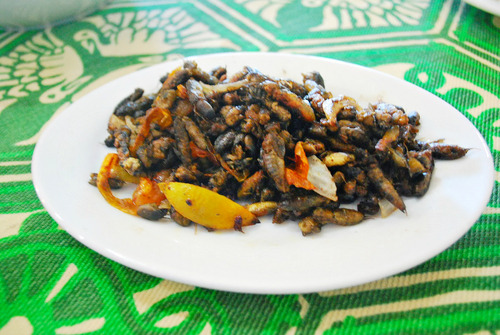
Pampanga – KamaruimageMostly, the main ingredients in Filipino exotic dishes are insects. One of it is adobong kamaru—probably one of the best culinary traditions in Pampanga. Kamaru is a mole cricket, from the family Gryllotalpidae. This insect is muscular; you can justify by holding one in the hand. Scientifically proven to be edible, they are close to a staple protein source sustaining 28% of the daily nutrient need.
They go very well with cold beer. They are crispy on the outside, and moist on the inside, making it a favorite pulutan (finger food) for the Kapampangans. Several restaurants in Pampanga serve this dish, including Everybody’s Café in San Fernando.
When preparing, it is recommended to remove the harder outer wings and legs before eating the creepy crawlers.

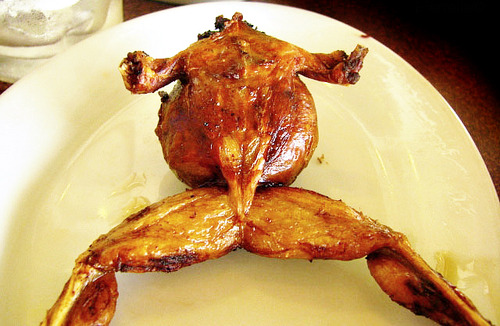
Pampanga - Betute (stuffed frogs)image
Betute is also one of Kapampangan exotic dishes. Farmers in Pampanga used to depend on rainwater to irrigate their farms. Children would then catch the frogs that came out during the rainy season, while their parents cultivate the lands. Outwitting the frogs has been a traditional “family bonding” ritual. Betute is a play of words on butete, which means “tadpole” in the local dialect. Betute is the entire frog stuffed with minced pork. It is then deep-fried in oil.
Nueva Ecija – Abal- Abalimage
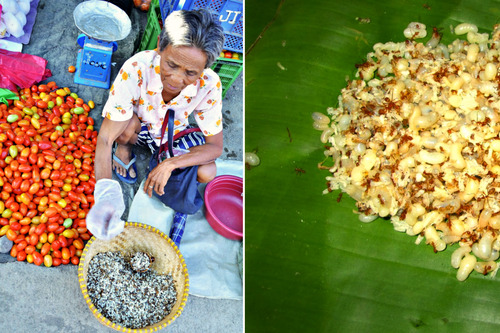
Abal- Abal, or salagubang is a common treat mostly in the northern part of the Philippines particularly Nueva Ecija, where many of these beetles thrive. These cheeping bugs inhabit agricultural fields and burrow themselves in soil, but also have wings and could fly. They are thick-bodied making them crunchy when toasted or stir-fried. The head is not included when you cook it because the snout is sharp and hard. Salagubang can be legally found in some markets in Nueva Ecija.
Rizal – Uok
Uok is a coconut rhinoceros beetle larva which can be found in dead coconut logs. This fat, eerie worm can be eaten raw but best when cooked adobo style. Adobong uok was featured in Andrew Zimmern’s (chef, food writer, and television personality) show called “Bizarre Foods” in Travel and Living Channel, where he described the taste as glutinous and earthy.
Ilocos – AbuosItlog ti abuos (fruit-tree ant eggs) is a popular delicacy in the northern parts of Luzon. Often sautéed in garlic and onions, this native dish, which looks a lot like roasted legumes, is a tasty treat that’s also claimed to be an effective aphrodisiac.
Egg harvesting season is usually done this time of the year extending until June. Gatherers scout dense forests for ants’ nests found clumped in trees by smoking them out so they can easily get the eggs without being stung.
Abuos eggs are a common offering in public markets in the north and because it’s a rare cuisine, like the famous Western dish, caviar, they are sold a tad bit pricy at P200 to P350.
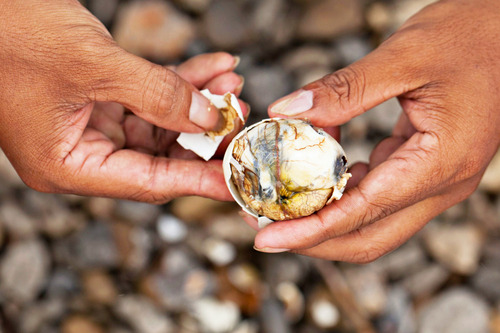
Balut - All over the PhilippinesThough considered an object of culinary fascination around the world and common eats among many Filipinos, there are still those who have yet to pluck up the courage to try balut because then, it is no beauty queen. Balut is a fertilized duck egg, either 16 or 18 days old, which has been boiled and is eaten with salt or vinegar, has revolted even the most daring foodies with its carnal textures, earning it lofty rankings on many a “most disgusting/strange/terrifying food” list.
While food journalists commonly label balut as the Philippines’ “much loved delicacy,” in reality Filipinos are decidedly split over their nation’s oft-sung snack.
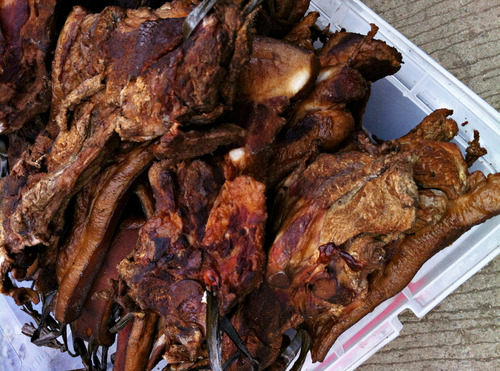
Cordillera Region – EtagEtag is an Igorot dish that is preserved small slab of meat (esp. pork) made through salt-treating, sun-drying or smoking. is salted pork that is kept underground in earthenware jars to age. It is not a dish in itself, as it is most often used as an ingredient in other viands, but it adds a very distinct flavor to meat or vegetable dishes. Its color is partly dark brown with noticeable whitish yellow fat color. 
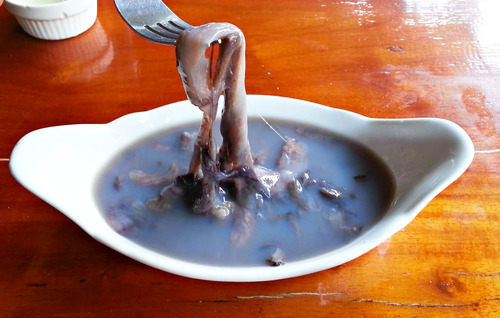
Palawan - Kinilaw na tamilok"Tommy, look!" were the words uttered by a foreign visitor when he and his companion chanced upon locals in Palawan eating raw woodworms with vinegar. Since then, the woodworms which usually hide in the crevices of the branches of the mangrove tree, known as bakawan have been called as tamilok.
Despite its technical name, woodworms aren’t worms at all; they’re mollusks, which is why they tend to have an oyster-like taste and texture. You won’t know until you try itMostly served kinilaw-style, the woodworms are soaked in vinegar with chilli peppers, onions, and calamansi juice.
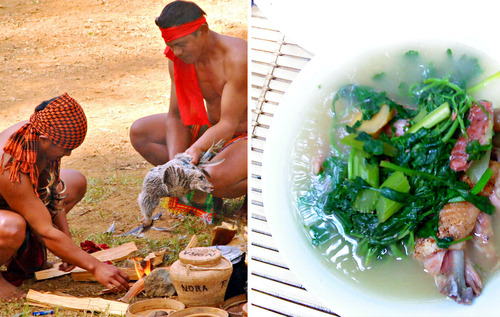
Cordillera Region – PinikpikanPinikpikan is a controversial yet famous native dish from the highlands of Cordillera. For some, it is an extreme eating, but looking closely at the end product, it looks pretty simple and plain delicious, near to tinola. The flavors of the dish come from the coagulated blood, the burned feathers and skin, and one special ingredient called Etag, which is a cured and smoked meat, aged and kept underground in earthen jars.
What makes Pinikpikan debated is how the chicken is slaughtered. The preparation involves a live chicken punctured with sticks before cooking.  It is a ritual performed by the Cordillera tribes to decide their fate. It takes hours of careful work to prepare an authentic Pinikpikan. The chicken is then battered to keep the blood inside. Also, none of the bones should be disjointed during the process of beating or even when slicing.
Manila and Cebu - Soup No. 5 or Lanciao
This exotic dish is not for the faint of heart. But sneer at it all you want, it has been cited by an international travel guide as among the notable features of Manila’s Chinatown.

Soup No. 5 looks like a regular meat soup but is actually made of bull or ox penis and testicles. The dish which probably originated from the creative Filipino roadside eateries is believed to have potent aphrodisiac properties, thus becoming one of the most challenging spurs among the bravest foodies especially the males. Particularly for those who prefer the natural ways of attaining sexual enthusiasm than with the help of tablets produced by medical science. 
Some restaurants in Binondo serve this dish, and it can also be found in Cebu, where it is known as Lanciao. 
no image

Sports: It’s More Fun in the Philippines

With its breathtaking landscapes and magnificent sceneries, the Philippines is truly a paradise to consider when talking about travel. The diverse wonders these 7,107 islands possess, tourists surely have the perfect place to stay for an exciting exploration and every imaginable way of adventure.

“I noticed that at on the back of the bills here (referring to P1000 cash denomination); you could see all the terraces and tons of water.” Brian Grubb said on a video where he was skating down a rail atop of one of the most beautiful spot in the world – the picturesque Banaue Rice Terraces in Ifugao. The professional wakeskater from United States showcased the centuries-old Eighth Wonder of the World from a different light. He added, “It’s just a wakeskate paradise but no one even knew it was here.” The stunt featured the serene majesty of the ancient tourist attraction, bringing together sports and tourism.

Sports Haven Destinations
Today, sports enthusiasts are also raving in the opportunity to explore the province of Pangasinan as a premiere sports tourism hub in the north. Committed to sports and youth development, Governor Amado T. Espino, Jr announced the opening of water sports adventures like Kayak, Dragon Boat, Parasailing, and Jetski in the province. 

Surfing in La Union and Siargao, white water rafting in Cagayan, boardsailing in Boracay, wakeboarding in Camarines Sur, scuba diving in Palawan, mountaineering in Mindanao, and kayaking in Subic are some of the sought-after adventure destination in the country. On all just about the corners of the country, travelers are loaded with attractions they ever dream of. No doubts that the Philippines is a fantastic spot for tourists who crave for a thrilling adventure.

Sporting Events
Seeking to encourage and stimulate sports tourism, the country hosted the FIBA Asia 2013 in early August where Gilas Pilipinas clinched a berth in the FIBA World Championship in 2014, and the NBA Global pre-season game between Indiana Pacers and Houston Rockets in the world-class basketball stadium at the Mall of Asia Arena.

With the emerging popularity of football, thousands of fans of Philippine Azkals are travelling around the country to catch their favorite players play against local and foreign teams during friendlies and FIFA sanctioned games. Matches held in stadiums, whether, Panaad in Bacolod, or Rizal Memorial Stadium, are usually flocked by local or even foreign fans, boosting local economy and tourism.

On the other hand, the country also attracts top pool players around the world to compete in prestigious international tournaments organized in the country annually. Tournaments like World Nine Ball Championships and World Ten Ball Championships are hosted in Manila, which is also known as the “Pool Capital of the World”.

Sports Tourism
Sports tourism, as recognized by the government and tourism industry, as an ideal avenue to spur tourism and economic growth, has opened more gateways to local businesses and services and has created employment opportunities.  In 2012, almost 4.2 million tourists visited the Philippines, climbing 12 notches higher in the World Economic Forum (WEF) 2013 Travel and Tourism Competitiveness Index. The country improved from 94th to 82nd overall out of 140, edging countries of the region as the most improved policy makers in the tourism industry.

There’s more to the Philippines than an extensive beaches and vast plains. Home to the gorgeous beaches, majestic sceneries, captivating culture and history, and welcoming locals, the nation of more than 7,000 islands has become a preferred spot for sports and adventure activities. The Philippines has truly transformed from an ordinary tropical spot to sporting event destination. It offers plenty of opportunities to explore that are favorable to sports, adventure, and recreational activities.

The regular staging of national and international sports events do not only underscore the world-class scenery, flair and skills of local athletes, but highlight the country as a legitimate sport tourism destination.


Friday, April 18, 2014
Meatless lent meal ideas

Meatless lent meal ideas

A seafood basket inspired for Lenten season; mussels, shrimp and scallops go into this dish. ©davewallis

Lent is not known as a time for haute cuisine. It seems that there are as many different faiths that observe Lent as there are rules for foods allowed during the observance period, making it especially hard to answer the question, “What’s for dinner?” at this time of year.

Tuna casserole, fish sticks, and mac and cheese—these are the standard Lent recipes of many Catholic households. But foodies and fast food chains think this is a time to create an intentional game plan for meatless battles that don’t have to mean bland food.

Since the 4th century, eating meatless and in some cases, eschewing of other animal products has been one way for millions of Christians to respect their religious heritage. Even when the restrictions are limited to Wednesdays or Fridays of each week, finding that family meal planning is essential.

You might say that those who observe the Lenten fast are the original flexitarians. But that doesn’t mean one has to end up with a lot less of something good. Again, people don’t like eating the same tuna casseroles.

Lent is not just a matter of self-denial.  Fasting comes with feasting also, and that those things are not at odds with each other. To help keep abstinence rewarding during the season, Focus Weekly rounded up 10 recipe ideas that cater to all the different dietary needs—whether you’re simply omitting red meat, avoiding dairy or striving for a strict vegetarian diet. From tasty Tilapia Fish Tacos to appetizing Pasta and Marina, we’re sure these will keep your Lenten days and nights full of flavor.
  1. Salmon with mongo beans. This heart-healthy dish is loaded with protein, and what fat it does have, is the good kind, from fresh salmon and olive oil. The mongo beans round out the dish, providing nutty taste and firm texture.
  2. Stir-fried tofu with vegetables. Here is a great way to show what a super meat substitute firm tofu is. If you wish, vary the vegetables. Small broccoli flowerets or zucchini strips can stand in for the carrots and mushrooms.
  3. Pasta with Mahimahi. Similar to grouper, mahimahi boasts a firm texture and light, sweetly moist meat. Paired with multigrain pasta, this extra lean fish dish is a delicious way to enjoy the benefits of heart-healthy seafood.
  4. Roasted bangus with coconut-ginger sauce. This protein-packed recipe is full of zesty flavor, with Caribbean jerk seasoning, coconut milk, garlic, and ginger adding depth to a medley of vegetables that are spread atop baked red snapper fillets.
  5. Osyter and asparagus stir-fry. Tossing this dish with chopped basil just before serving adds a touch of fresh flavor. With steamed rice, you have a complete meal!
  6. Jerk tuna fillet with sweet potato sides. Tuna, a firm-fleshed fish, is often sold as fillets, but it's one of the few fish thick enough to be cut into steaks — which are usually a better buy.
  7. Flatbread salad pizza. Try this salad "pizza" as an alternative to the usual tomato-and-cheese kind. It's especially good because it starts with a crusty grilled flatbread that gives it a unique look and imparts a rustic flavor. Serve the bread simply with herb-infused olive oil and fresh herbs, or top with our chopped salad or spice blend.
  8. Vegetable Stew. A hearty vegetable stew makes an incredible vegetarian entrée—savory and satisfying with plenty of spices and seasoning to keep your palate interested. For a variation, try stirring toasted, chopped almonds and scallions into the couscous before serving.
  9. Fisherman's Stew. This simple seafood stew is laden with fresh shrimp and cod, and features a savory tomato broth spiced up with herb seasoning.
  10. Baked cabbage. Cabbage wedges are microwaved, then topped with a sweet-and-sour tomato sauce—a simplified version of the classic stuffed cabbage! Delicious served over quick-cooking brown rice.

P.S. For fries patrons out there, Mcdo’s new innovation addition called BFF Fries is the Lenten bomb. It’s big enough to be shared with a friend or two. - Louie dela Vega (FOCUS)
Copyright © 2012 Focus Weekly All Right Reserved
UA-51113051-1